A Defensible Case on AI — storyboard review
Four chapters, between about one and two minutes each, built from the evidence briefing. Each chapter card on the deck shows that chapter's storyboard sheet; this page holds the sheets at full size, the scripts, the narrator sample and the claims ledger.
The narrator (Kokoro, local, voice am_michael) reading script-shaped lines, including the numbers:
01 Five drops
127s · 11 frames · open the full storyboard sheet
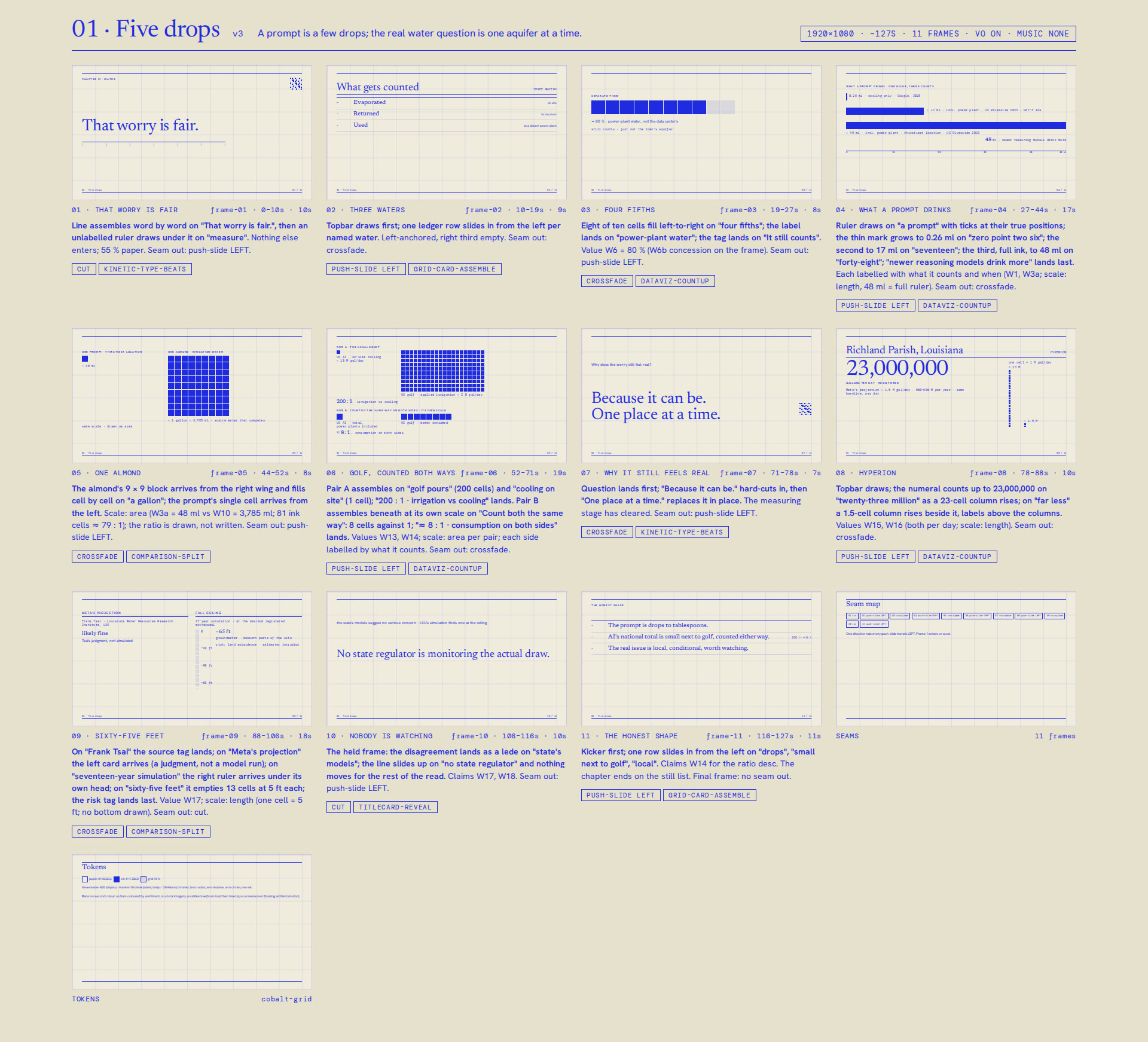
Frames
- 01 · That worry is fair
- 02 · Three waters
- 03 · Four fifths
- 04 · What a prompt drinks
- 05 · One almond
- 06 · Golf, counted both ways
- 07 · Why it still feels real
- 08 · Hyperion
- 09 · Sixty-five feet
- 10 · Nobody is watching
- 11 · The honest shape
Script (default-accepted; veto window closes when the build starts)
Line 1 — That worry is fair (Frame 1)
A family in Louisiana turns on the tap and wonders what the data center is drinking. That worry is fair. Let's measure.
Line 2 — Three waters (Frame 2)
Scary numbers add up three waters: evaporated on site, returned to the river, and used at a distant power plant.
Line 3 — Four fifths (Frame 3)
Separate them: roughly four fifths is power-plant water. It still counts; it just isn't the town's aquifer.
Line 4 — What a prompt drinks (Frame 4)
What does a prompt drink? Google counts about zero point two six millilitres, cooling only. An older independent study, power plant included, found about seventeen millilitres on average, forty-eight in the thirstiest place. Newer reasoning models drink more.
Line 5 — One almond (Frame 5)
Now an almond. One almond takes about a gallon of irrigation water, drawn from scarce water that actually competes.
Line 6 — Golf, counted both ways (Frame 6)
Zoom out. American golf pours about two billion gallons a day on grass; all of American AI, cooling on site, about ten million. Two hundred to one. Count both the same way, consumption with power plants included, and golf still leads about eight to one.
Line 7 — Why it still feels real (Frame 7)
Why does the worry still feel real? Because it can be, one place at a time.
Line 8 — Hyperion (Frame 8)
Meta's Hyperion site in Richland Parish is registered to draw more than twenty-three million gallons a day. Meta projects far less.
Line 9 — Sixty-five feet (Frame 9)
LSU's Frank Tsai expects the aquifer to be fine at Meta's projection. His team's seventeen-year simulation, run at the full ceiling, finds groundwater dropping more than sixty-five feet beneath parts of the site, with a risk of sinking land and saltwater.
Line 10 — Nobody is watching (Frame 10)
The state's models suggest no serious concern; LSU's simulation finds one at the ceiling. And no state regulator is monitoring the actual draw.
Line 11 — The honest shape (Frame 11)
The prompt is drops to tablespoons. AI's national total is small next to golf, counted either way. The real issue is local, conditional, worth watching.
02 What it caught
68s · 6 frames · open the full storyboard sheet
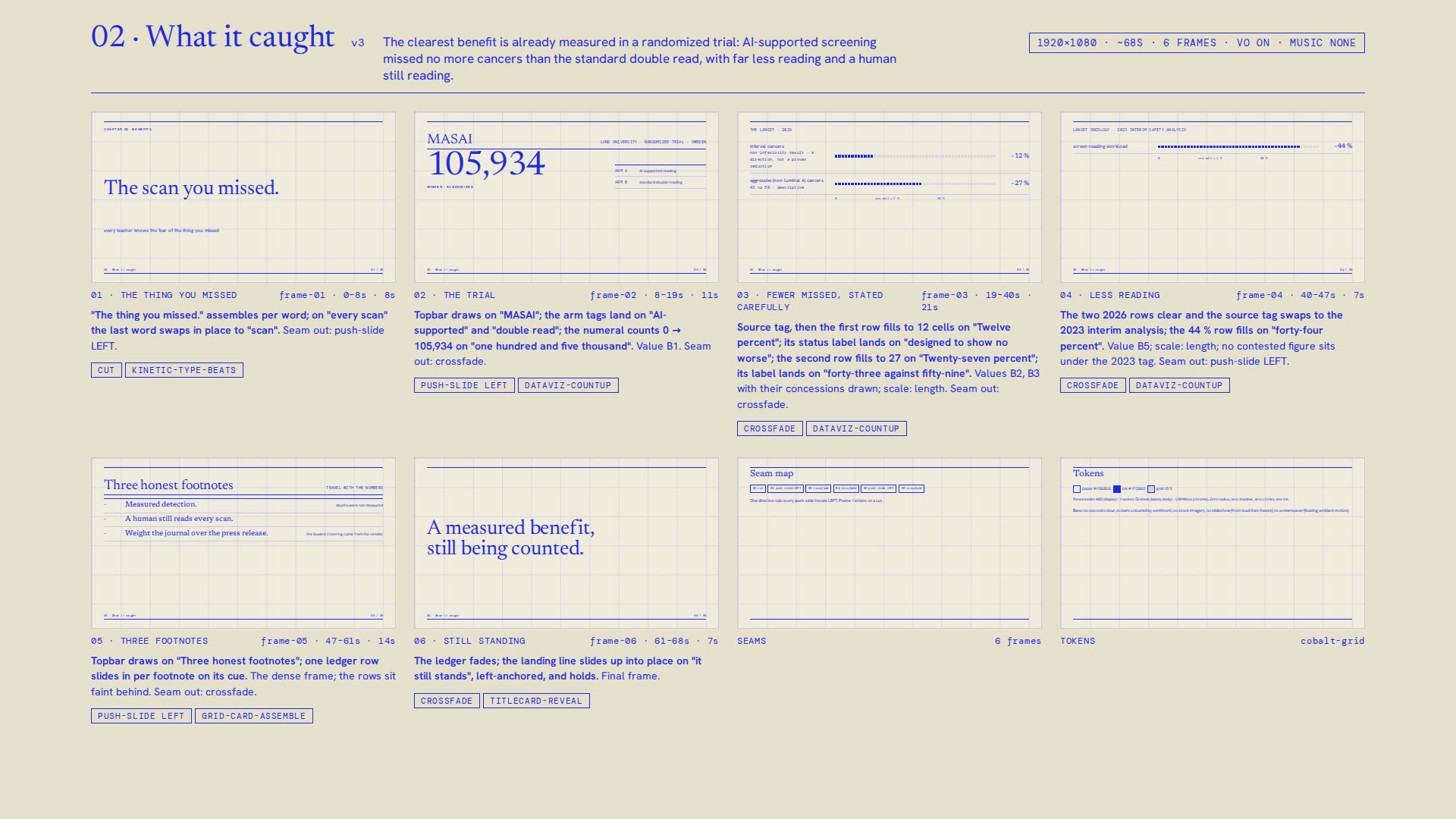
Frames
- 01 · The thing you missed
- 02 · The trial
- 03 · Fewer missed, stated carefully
- 04 · Less reading
- 05 · Three footnotes
- 06 · Still standing
Script (default-accepted; veto window closes when the build starts)
Line 1 — The thing you missed (Frame 1)
Every teacher knows the fear of the thing you missed. Radiologists live with it on every scan.
Line 2 — The trial (Frame 2)
In Sweden, the MASAI trial tested AI-supported screening against the standard double read: one hundred and five thousand, nine hundred and thirty-four women, randomized.
Line 3 — Fewer missed, stated carefully (Frame 3)
Published in The Lancet in twenty twenty-six. Twelve percent fewer cancers surfaced between screenings; the trial was designed to show no worse, and it did, so call twelve a direction, not a proven reduction. And twenty-seven percent fewer aggressive cancers, forty-three against fifty-nine: a small, descriptive count.
Line 4 — Less reading (Frame 4)
In the trial's earlier safety analysis, radiologists' screen-reading workload fell by forty-four percent.
Line 5 — Three footnotes (Frame 5)
Three honest footnotes. It measured detection, not deaths. A human still reads every scan. And the loudest cheering came from the vendor, so weight the journal, not the press release.
Line 6 — Still standing (Frame 6)
With the footnotes attached, it still stands: a measured, population-scale benefit, still being counted.
03 Who holds it
78s · 7 frames · open the full storyboard sheet
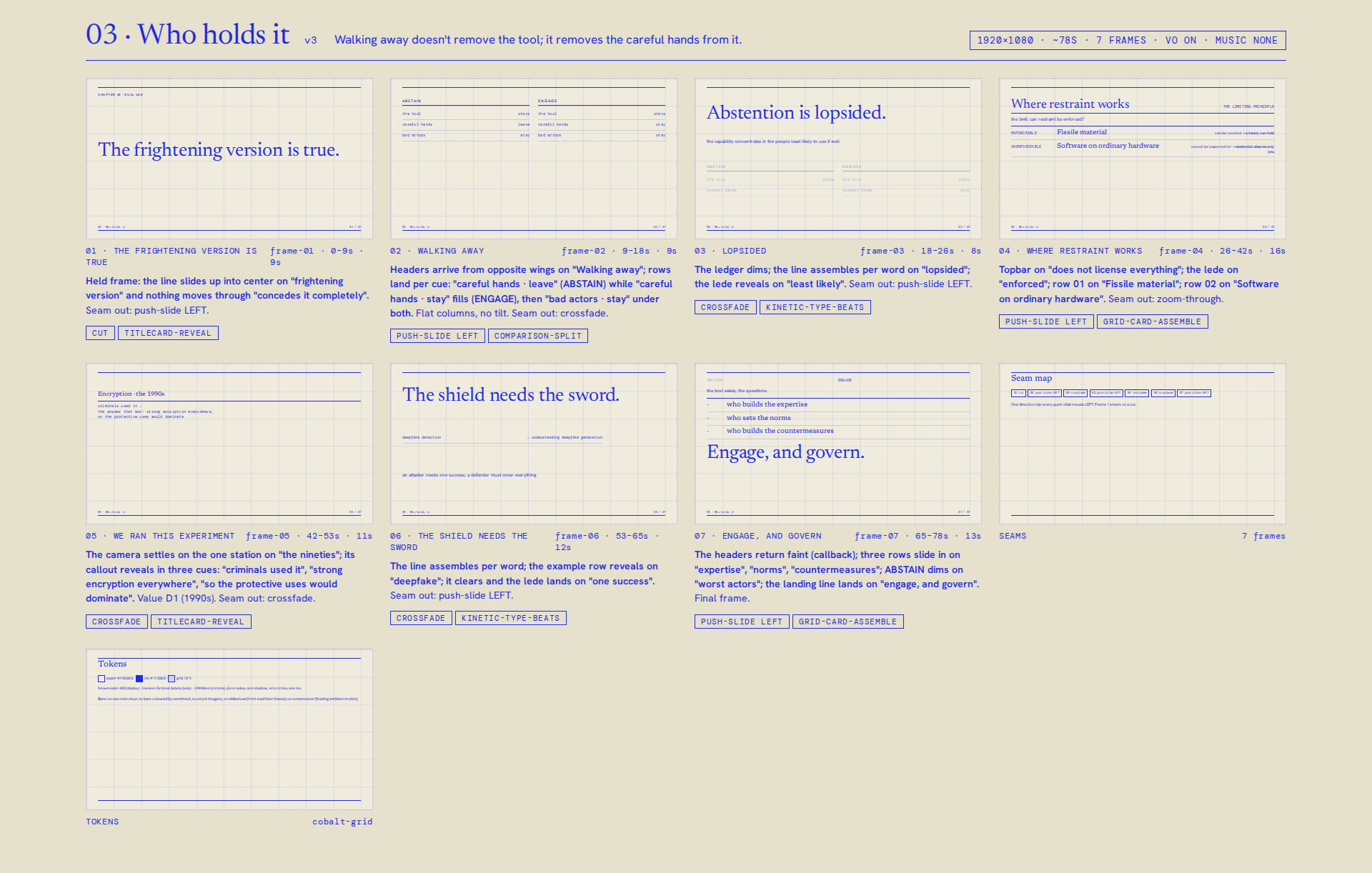
Frames
- 01 · The frightening version is true
- 02 · Walking away
- 03 · Lopsided
- 04 · Where restraint works
- 05 · We ran this experiment
- 06 · The shield needs the sword
- 07 · Engage, and govern
Script (default-accepted; veto window closes when the build starts)
Line 1 — The frightening version is true (Frame 1)
The frightening version is true. A tool this powerful will be misused. Start there; the argument that follows concedes it completely.
Line 2 — Walking away (Frame 2)
Walking away does not make the tool disappear. It takes the careful hands off it while bad actors never ask permission.
Line 3 — Lopsided (Frame 3)
So abstention is lopsided: it concentrates the capability in the people least likely to use it well.
Line 4 — Where restraint works (Frame 4)
That does not license everything. The limit is whether restraint can be enforced. Fissile material can be counted, so a treaty can hold. Software on ordinary hardware cannot be inspected for, so abstention buys only your own disarmament.
Line 5 — We ran this experiment (Frame 5)
We ran this experiment in the nineties with encryption. Criminals used it. The answer that won was strong encryption everywhere, so the protective uses would dominate.
Line 6 — The shield needs the sword (Frame 6)
The shield needs the sword: you cannot detect a deepfake without understanding how one is made. An attacker needs one success; a defender must cover everything.
Line 7 — Engage, and govern (Frame 7)
The tool exists. The questions are who builds the expertise, who sets the norms, who builds the countermeasures. Walking away answers every one for the worst actors. Engage, and govern.
04 Augment or atrophy
125s · 9 frames · open the full storyboard sheet
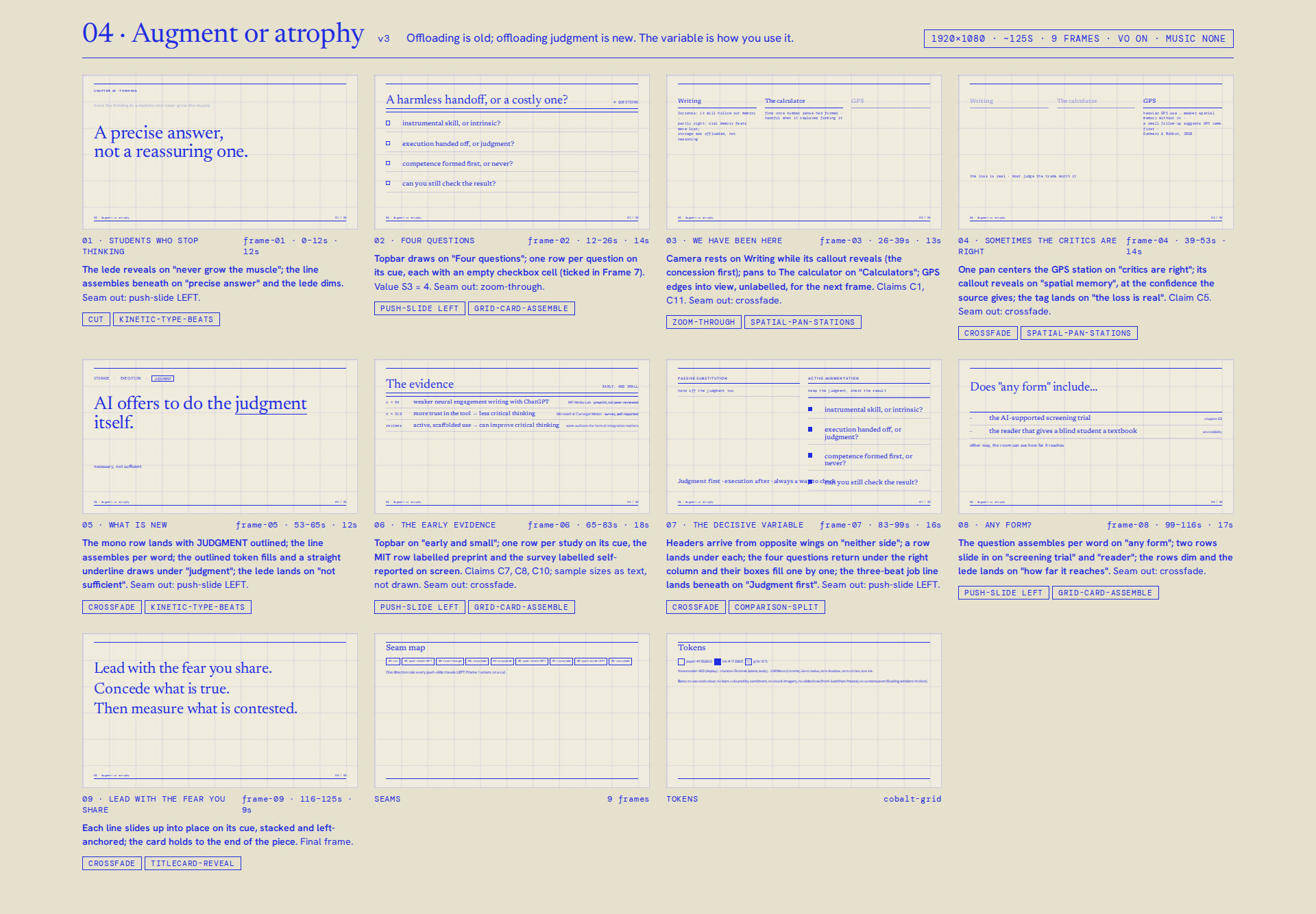
Frames
- 01 · Students who stop thinking
- 02 · Four questions
- 03 · We have been here
- 04 · Sometimes the critics are right
- 05 · What is new
- 06 · The early evidence
- 07 · The decisive variable
- 08 · Any form?
- 09 · Lead with the fear you share
Script (default-accepted; veto window closes when the build starts)
Line 1 — Students who stop thinking (Frame 1)
The staff-room fear is simple: students who hand the thinking to a machine and never grow the muscle. It deserves a precise answer, not a reassuring one.
Line 2 — Four questions (Frame 2)
Four questions separate a harmless handoff from a costly one. Instrumental skill, or intrinsic? Execution handed off, or judgment? Competence formed first, or never? Can you still check the result?
Line 3 — We have been here (Frame 3)
We have been here. Socrates feared writing would hollow out memory; he was partly right. Calculators were fine once number sense had formed, harmful when they replaced forming it.
Line 4 — Sometimes the critics are right (Frame 4)
Sometimes the critics are right: heavier GPS users had weaker spatial memory, and a small follow-up suggests the GPS came first. Most of us judge the trade worth it; the loss is real.
Line 5 — What is new (Frame 5)
Every earlier tool took storage or execution and left the judgment to a person. AI offers to do the judgment itself. The old reassurances are necessary, not sufficient.
Line 6 — The early evidence (Frame 6)
The evidence is early and small. An MIT preprint of fifty-four writers saw weaker neural engagement with ChatGPT in hand. A survey of three hundred and nineteen knowledge workers linked more trust to less critical thinking. Active, scaffolded use can improve it.
Line 7 — The decisive variable (Frame 7)
Read honestly, it vindicates neither side. The decisive variable is passive substitution versus active augmentation, the line the four questions draw. So: teach the tool well. Judgment first, execution after, and always a way to check.
Line 8 — Any form? (Frame 8)
If a colleague says no AI in any form, ask gently whether any form includes the screening trial from the second chapter, or the reader that gives a blind student a textbook. Either way, the room can see how far it reaches.
Line 9 — Lead with the fear you share (Frame 9)
Lead with the fear you share. Concede what is true. Then measure what is contested.
LEDGER Claims
Every number spoken or shown traces to a row here, and each row to a numbered reference in the briefing. Rows marked contested carry their concession on screen; rows marked dropped never appear.
# CLAIMS — the ledger every spoken or shown number traces through

Source: `source/briefing.md` (Kyle's "A Defensible Case on AI: Evidence Briefing", 24 numbered
references `[n]`). Gate: `scripts/check-claims.mjs` (Decision 8) reads this file; keep the
block shape below or the checker cannot see a row.

**Row shape.** One `### <ID> — <title>` heading per row, then `- key: value` lines:
`refs` (briefing reference ids), `tier`, `values` (`;`-separated numbers this row licenses,
in any form the checker's tokenizer reads), `names` (study / source names, `,`-separated, used to
trace named studies), `used-by` (chapters, `candidate`, or `none`), `briefing says`,
`source says` (the external note from Phase 1 step 3: what the source itself says),
`dispute`, `concession` (suggested on-screen / spoken wording for a `contested` row),
`must-say` / `never-say` (`|`-separated alternatives the checker enforces on any line or frame
that uses the row), `status: dropped` + `phrases` for items the briefing drops, `xv` (which
logged calls in `state/log` the note rests on).

**Tiers.** `verified` = an external source read in the 2026-10-06 pass says what the row says.
`carried` = the briefing's in-session source, not re-read here (or only partly confirmed).
`established` = long-standing literature, not re-read. `contested` = a source shows a dispute,
a failed replication, or a framing the source does not support: usable only with its
`concession` on screen or in audio (the frame carries `concession:`). `low` = unsourced or
low-confidence: the checker fails any use. `framing` (added by Phase 1, see
`verify/phase1-build.md`) = a count of the briefing's own structure ("three distinctions"),
sourced to the briefing text itself; no external call applies.

**External pass, 2026-10-06.** 15 `sharedClient.search` + 23 `sharedClient.scrape` calls
(caps 30 / 30), every one logged in `state/log`. "search #n" / "scrape #n" below number the
calls in log order. Rows whose primary source blocked the VPS say so; their note then rests on
the search-result text of the primary page, quoted as such.

---

## Water and the environment (chapter 01)

### W1 — Google: median Gemini text prompt ≈ 0.26 mL of water (about five drops)
- refs: [1]
- tier: verified
- values: 0.26; 5; 2025
- names: Google, Gemini
- used-by: 01
- briefing says: "Google's 2025 environmental reporting puts a median Gemini text prompt at about 0.26 milliliters of water, roughly five drops, using a method that includes cooling, idle capacity, and overhead."
- source says: DCD (scrape #10): "the median Gemini Apps text prompt uses 0.24 watt-hours (Wh) of energy … and consumes 0.26 milliliters (or about five drops) of water"; methodology covers accelerators, host CPU/DRAM, idle provisioning and data-center overhead; "experts" note it omits indirect water: "the study only including water that data centers use in cooling, and not the water needed for large generation projects". Google's own blog and arXiv 2508.15734 carry the same figure (search #6).
- dispute: company self-report; on-site cooling only, no power-plant water. Label it as Google's own on-site count; never place it on one ruler with W3 without labelling what each counts (Decision 4).
- xv: search #6 · scrape #10

### W2 — OpenAI (Altman): ≈ 0.32 mL per average ChatGPT query
- refs: [1]
- tier: carried
- values: 0.32
- names: Altman, OpenAI
- used-by: none
- briefing says: "about 0.32 milliliters … without a published methodology, so it is best read as a plausible floor for on-site use."
- source says: not re-read (row unused).
- xv: none

### W3 — UC Riverside (Making AI Less Thirsty): "roughly 10 to 25 mL per query" including power generation
- refs: [3]
- tier: contested
- values: 10; 25; 2023
- names: UC Riverside, Making AI Less Thirsty, Shaolei Ren
- used-by: 01
- briefing says: "roughly 10 to 25 milliliters per query, because it adds the water used to generate the electricity."
- source says: the paper's own table (arXiv 2304.03271v5, scrape #13), GPT-3 water per request: U.S. average 2.200 mL on-site + 14.704 mL off-site = 16.904 mL total; by location the total runs from 7.107 mL (Ireland) to 47.506 mL (Washington state); U.S. states alone run 7.590 (Texas) to 47.506 mL. The current abstract (v5, scrape #12) gives no per-query figure.
- dispute: the source's range is about 7–48 mL by location, wider than the briefing's 10–25; the briefing's band brackets the U.S. average (≈ 17 mL) but understates the top. Figures are for GPT-3; the briefing itself notes newer reasoning models are thirstier.
- concession: "It depends where it runs: about seventeen millilitres on the U.S. average, counting the power plant, and up to about forty-eight in the thirstiest location." (Or use W3a instead of this row.)
- xv: search #7 · scrape #11 (returned only site navigation, no article text) · scrape #12 · scrape #13

### W3a — UC Riverside, U.S. average per request: 2.2 mL on-site + 14.7 mL for electricity ≈ 16.9 mL total (range ≈ 7–48 mL by location)
- refs: [3] (names the study); the 16.9 / 7–48 figures are from the paper itself, arXiv 2304.03271v5 Table (scrape #13), outside the briefing's text — the review page lists the paper so the swap from the briefing's "10 to 25" is visible
- tier: verified
- values: 16.9; 17; 2.2; 14.7; 7; 7.1; 47.5; 48; 2023
- names: UC Riverside, Making AI Less Thirsty, Shaolei Ren
- used-by: 01 (candidate replacement for W3)
- briefing says: "it found on-site cooling alone at about 2.2 milliliters for the average US data center" (the total is not in the briefing; it is in the source).
- source says: see W3: U.S. average 2.200 (on-site) + 14.704 (off-site) = 16.904 mL per GPT-3 request; location range 7.107–47.506 mL (scrape #13).
- dispute: GPT-3-era estimate; reasoning models use more per query.
- xv: search #7 · scrape #13

### W4 — UC Riverside: on-site cooling ≈ 2.2 mL per query (U.S. average data center)
- refs: [3]
- tier: verified
- values: 2.2; 2023
- names: UC Riverside, Making AI Less Thirsty
- used-by: 01 (candidate)
- briefing says: "on-site cooling alone at about 2.2 milliliters for the average US data center."
- source says: paper table (scrape #13): U.S. average on-site water per request 2.200 mL; The Register snippet (search #7): "UC Riverside's on-site average of 2.2ml for US datacenters … first published in 2023".
- xv: search #7 · scrape #13

### W5 — "A bottle of water per email" ≈ 519 mL (UC Riverside lab, full lifecycle)
- refs: [3]
- tier: carried
- values: 519
- names: bottle of water per email
- used-by: none
- briefing says: "around 519 milliliters, comes from that same lab but bundles the full lifecycle."
- source says: not re-read (row unused).
- xv: none

### W6 — About 80 % of the water attributed to AI is off-site power-plant water ("a gallons headline can be ten times" the water consumed inside)
- refs: [1], [2]
- tier: verified
- values: 80; 10; 0.8
- derived: 0.8 = four fifths, the spoken form of 80 % (Phase 2)
- names: Andy Masley
- used-by: 01
- briefing says: "roughly 80 percent of the water attributed to AI turns out to be offsite power-plant water, much of it non-consumptive … a single 'gallons' headline can be ten times larger than the water actually consumed inside a data center."
- source says: the off-site share is if anything larger than 80 %: UC Riverside's U.S. average is 14.7 of 16.9 mL off-site = 87 % (scrape #13); LBNL's 2023 national figures, as reported by NOLA (scrape #17), are ≈ 17 billion gallons on-site vs ≈ 211 billion gallons "for electricity generation" (≈ 93 % off-site, total ≈ 13× the on-site number).
- dispute: none on the share; the "non-consumptive" half of the sentence is W6b.
- xv: scrape #13 · search #10 · scrape #17

### W6b — "much of it non-consumptive" (the off-site water)
- refs: [1], [2]
- tier: contested
- values: none
- used-by: 01
- briefing says: "offsite power-plant water, much of it non-consumptive."
- source says: Buttondown's reading of LBNL (scrape #16): its ≈ 210 billion gallons of electricity water is a consumption figure ("The figures are consumption, not withdrawal"), built on a grid-average intensity that "includes evaporation off hydropower reservoirs"; the same piece argues the marginal (new gas + renewables) intensity is far lower. So the source supports "off-site, not from the local aquifer", not "largely non-consumptive".
- dispute: the consumptive/non-consumptive split for off-site water is not settled by these sources; the defensible distinction is local vs off-site.
- concession: "Most of that water is used far away, at power plants, not drawn from the town's aquifer; it still counts, it just isn't local."
- xv: search #9 · scrape #16 · scrape #17

### W7 — Beef ≈ 1,847 gal/lb, ≈ 94 % green (rain) water
- refs: [4], [5]
- tier: carried
- values: 1847; 94
- names: Mekonnen, Hoekstra
- used-by: none
- briefing says: "about 1,847 gallons per pound … roughly 94 percent of that is green water."
- source says: not re-read (row unused).
- xv: none

### W8 — Beef blue water ≈ 100–160 gal/lb ("conservative US estimates")
- refs: none
- tier: low
- values: 100; 160
- used-by: none
- briefing says: "on the order of 100 to 160 gallons per pound on conservative US estimates."
- source says: the briefing cites no reference for this range; not searched (row unused). Source it before any use.
- xv: none

### W9 — One pound of beef ≈ 20,000 prompts' worth of competing water
- refs: none (derived from W8 and W3)
- tier: low
- values: 20000
- used-by: none
- briefing says: "a single pound of beef equals roughly 20,000 prompts' worth of competing water."
- source says: derived from the unsourced W8 range; not usable until W8 is sourced.
- xv: none

### W10 — One almond ≈ one gallon of irrigation water (estimates ≈ 0.75–1.7)
- refs: [6], [7]
- tier: verified
- values: 1; 0.75; 1.1; 1.6; 1.7; 3785
- derived: 3785 = one US gallon in millilitres (unit conversion, 3.785 L), used to draw the almond's gallon beside a per-prompt figure in millilitres (Phase 2)
- names: Pacific Institute, Almond Board
- used-by: 01
- briefing says: "A single almond takes roughly one gallon, with credible estimates ranging from about 0.75 to 1.7 gallons depending on method."
- source says: Farmonaut (scrape #14): "One California almond kernel takes about 1.1 gallons of water to produce, according to the Almond Board of California. An earlier peer-reviewed estimate from the Pacific Institute … put the number closer to 1.6–1.7 gallons per kernel." Pacific Institute snippet (search #8): "almonds required between 1.6 and 1.7 gallons of water per nut, somewhat higher than the 1 gallon per nut commonly reported".
- dispute: the 0.75 low end was not found in these sources; "about a gallon" is the industry's lower figure and the independent estimate is higher, which strengthens the comparison rather than weakening it.
- xv: search #8 · scrape #14

### W11 — Almonds 520–560 gal/lb (Pacific Institute, California); 1,900–2,100 gal/lb full footprint
- refs: [6], [7]
- tier: verified
- values: 520; 560; 1900; 2100
- names: Pacific Institute
- used-by: none
- briefing says: "the Pacific Institute's conservative California-specific figure is about 520 to 560 gallons, while full water-footprint accounting reaches 1,900 to 2,100."
- source says: Farmonaut (scrape #14): "The Pacific Institute's analysis calculates 520–560 gallons of water per pound of almonds produced".
- xv: search #8 · scrape #14

### W12 — Almonds ≈ 9–10 % of California's agricultural water (debated)
- refs: [7], [8]
- tier: contested
- values: 9; 10
- used-by: none
- briefing says: "a figure that is itself debated and often inflated, with the industry citing under 9 percent."
- source says: not re-read (row unused).
- concession: "a debated share: the industry says under nine percent."
- xv: none

### W13 — U.S. data centers ≈ 50 million gal/day on-site; AI ≈ 15–20 % of it ≈ 10 million gal/day
- refs: [9], [10] (LBNL totals via NOLA)
- tier: contested
- values: 50 million; 15; 20; 10 million; 17 billion; 211 billion; 2023
- derived: (the ×12 factor used in an earlier draft was removed in Phase 2 after verification; the like-for-like comparison now lives in W14)
- names: Lawrence Berkeley National Laboratory, LBNL
- used-by: 01
- briefing says: "all US data centers use roughly 50 million gallons per day for on-site cooling, of which AI is about 15 to 20 percent, so somewhere near 10 million gallons per day."
- source says: LBNL's December 2024 report, as quoted by NOLA (scrape #17) and Buttondown (scrape #16): 2023 U.S. data centers used ≈ 17 billion gallons on-site (≈ 47 million gal/day, consistent with the briefing's 50 million) plus ≈ 211 billion gallons for their electricity. The 15–20 % AI share was not found in these sources; Buttondown puts AI's total (with electricity) near 52 billion gal/yr. Other outlets (search #9: TNW, Montgomery Advertiser) cite ≈ 449 million gal/day "used by U.S. data centers for cooling", a different (larger) accounting.
- dispute: the 50 million / 10 million figures are on-site only; counting power-plant water the data-center total is ≈ 13× larger, and one widely quoted figure is ≈ 449 million gal/day.
- concession: "That's on-site cooling only. Count the power plants that run them and data centers use roughly thirteen times more."
- xv: search #9 · scrape #15 · scrape #16 · scrape #17

### W14 — U.S. golf courses ≈ 2 billion gal/day; golf out-consumes American AI ≈ 200 to 1
- refs: [9]
- tier: contested
- values: 2 billion; 2.08 billion; 200; 1; 8
- derived: 8 = golf's water actually consumed (≈ 425 billion gal/yr, scrape #16) ÷ AI's total footprint including electricity (≈ 52 billion gal/yr, scrape #16) ≈ 8.2 — the like-for-like companion to 200 : 1, which sets golf's applied irrigation against AI's on-site cooling slice (Phase 2, after verify round 1)
- names: GCSAA, Golf Course Superintendents Association
- used-by: 01
- briefing says: "US golf courses use about 2 billion gallons per day. Golf out-consumes the entirety of American AI by roughly two hundred to one."
- source says: GCSAA estimates 2.08 billion gal/day applied for irrigation (search #9 snippets; AKCP scrape #15: "up to 2.08 billion"). Buttondown (scrape #16): golf's 2024 applied water was 1.63 million acre-feet (531 billion gal/yr), ≈ 425 billion gal/yr actually consumed; golf consumes ≈ 24× data centers' on-site water but only ≈ 1.9× their total footprint including electricity; against AI's total (≈ 52 billion gal/yr) that is ≈ 8×.
- dispute: 200:1 sets golf's applied irrigation against AI's on-site cooling slice. Counted the same way on both sides (total consumption), golf's lead is single digits for AI and under 2× for all data centers.
- concession: "Counting only on-site cooling. Count the power plants too and golf's lead shrinks to a few times, not two hundred."
- xv: search #9 · scrape #15 · scrape #16

### W15 — Meta's Hyperion (Richland Parish, Louisiana): registered for > 23 million gal/day (8.4 billion gal/yr)
- refs: [10], [11]
- tier: verified
- values: 23 million; 23; 8.4 billion; 8.4
- names: Hyperion, Meta, Richland Parish
- used-by: 01
- briefing says: "The site is registered to consume more than 23 million gallons per day, or 8.4 billion gallons per year."
- source says: NOLA (scrape #17): "registered to consume more than 23 million gallons of water per day, or 8.4 billion gallons per year, according to state records and the company itself"; six wells originally ≈ 36 million gal/day, lowered to 23 million; Louisiana requires only well registration: "the oversight essentially stops there".
- dispute: a ceiling, not expected use (W16). Prefer "registered to draw up to" over "permit": the state registers wells; it does not license a usage volume.
- xv: search #10 · scrape #17

### W16 — Meta projects 500–600 million gal/yr (≈ 1.5 million gal/day), closed loop, from the Mississippi River Alluvial Aquifer
- refs: [12], [10]
- tier: verified
- values: 500 million; 600 million; 1.5 million; 2028; 17000
- names: Meta, Mississippi River Alluvial Aquifer
- used-by: 01 (candidate)
- briefing says: "Meta projects actual use far below that ceiling, around 500 to 600 million gallons per year … through a closed-loop system."
- source says: NOLA (scrape #17): "between 500 to 600 million gallons per year once it is up and running in 2028, or an average of 1.5 million gallons per day", "comparable to what around 17,000 residents consume each day", drawn from the Mississippi River Alluvial Aquifer through a "closed-loop" system; NOLA adds that closed loop needs more energy, so more water at the gas plants powering it.
- dispute: a company projection, not a measurement; nobody is required to report actual use (W18).
- xv: search #10 · scrape #17

### W17 — LSU's 17-year simulation at the maximum registered withdrawal: groundwater drops more than 65 ft beneath parts of the site
- refs: [11], [10] (the note, including the state's dissenting models, is NOLA [10])
- tier: verified
- values: 17; 65
- names: LSU, Frank Tsai, Tsai, Louisiana Water Resources Research Institute
- used-by: 01
- must-say: maximum|max|ceiling|full|allowed|permitted
- briefing says: "his team's 17-year simulation at the maximum permitted withdrawal showed groundwater dropping more than 65 feet beneath parts of the site."
- source says: NOLA (scrape #17): "Frank Tsai, the director of the Louisiana Water Resources Research Institute at LSU, agreed that if Meta only used the lower amount it predicted — versus its maximum allowance — the aquifer would not likely be negatively impacted" (a judgment, not a simulation; re-fetched in verify round 3); "Tsai's team ran a 17-year simulation assuming Meta withdrew the maximum daily allowable amount. It found that groundwater levels dropped over 65 feet beneath some areas of the facility"; "long-term pumping at the maximum registered 23 million gallons per day could harm the environment"; risks named: land sinking and saltwater intrusion. Counterpoint in the same piece: the state Department of Conservation and Energy says its models suggest "no serious environmental concern".
- dispute: conditional on maximum pumping, which Meta says it will not do; the state's own models disagree with the concern.
- xv: search #10 · scrape #17

### W18 — No regulatory body monitors Meta's actual water use or the aquifer's condition
- refs: [10]
- tier: verified
- values: none
- used-by: 01
- briefing says: "there is no regulatory body monitoring Meta's actual usage or the aquifer's condition over time."
- source says: NOLA (scrape #17): "there is no state regulatory body tasked with monitoring Meta's water usage or the condition of the aquifer over time"; former DCE secretary Tyler Gray: "There's no actual scrutiny on the use of public resources"; the department's spokesman "confirmed the lack of regulatory power"; industrial users "are not required to report how much they consume".
- xv: search #10 · scrape #17

### W19 — The NYT "taps ran dry" story: construction sediment, municipal water
- refs: [13]
- tier: carried
- values: none
- names: New York Times
- used-by: none
- briefing says: "caused by construction sediment rather than the data center's operation, at a facility that draws municipal water."
- source says: not re-read (row unused).
- xv: none

## Benefits (chapter 02)

### B1 — MASAI: 105,934 women randomized; the first randomized trial of AI in breast-cancer screening (Sweden, Lund University, Kristina Lång)
- refs: [14], [15]
- tier: verified
- values: 105934; 100000; 105000; 2021; 2022
- names: MASAI, Mammography Screening with Artificial Intelligence, Lund University, Lund, Kristina Lång, Lång
- used-by: 02
- briefing says: "randomized 105,934 women and is the first randomized controlled trial of AI in breast cancer screening."
- source says: the Lancet article's ScienceDirect page (search #4): "trial population of 105 934 participants"; ecancer (scrape #9): randomized April 2021–December 2022 at four Swedish sites, analysed 53,043 (AI) + 52,872 (control) = 105,915 (the ASCO Post headline in search #4 notes 19 excluded); the vendor release (scrape #6): "over 105,000 women", "first-of-its kind trial".
- xv: search #4 · scrape #6 · scrape #9

### B2 — 12 % fewer interval cancers with AI-supported screening (The Lancet, January 2026)
- refs: [14], [16]
- tier: contested
- values: 12; 1.55; 1.76; 0.88; 82; 93; 2026
- names: The Lancet, Lancet
- used-by: 02
- briefing says: "found a 12 percent reduction in the rate of interval cancers … compared with standard double reading by radiologists."
- source says: the Lancet abstract (search #4 result text from thelancet.com; the page itself timed out, scrape #7): "Interval cancer rates were 1·55 (95% CI 1·23–1·92) and 1·76 (1·42–2·15) per 1000 participants in the intervention and control group respectively, a non-inferior proportion ratio of 0·88 (95% CI 0·65–1·18; p=0·41)." ecancer (scrape #9) reports the same counts (82/53,043 vs 93/52,872) as "a 12% reduction"; the vendor release (scrape #6) as "a non-inferior 12% reduction".
- dispute: the source disagrees with the briefing's confidence. 12 % is the point estimate of a non-inferiority result whose confidence interval includes no difference (p = 0.41). "Twelve percent fewer in this trial" is accurate; "AI reduces missed cancers by 12 %" is not established.
- concession: "Twelve percent fewer, though the trial reports it as no worse than two radiologists, not as a proven reduction."
- xv: search #4 · scrape #6 · scrape #7 (timeout) · scrape #9

### B3 — 27 % fewer aggressive (non-luminal A) interval cancers
- refs: [14], [16]
- tier: contested
- values: 27; 43; 59
- names: The Lancet, Lancet
- used-by: 02
- briefing says: "27 percent fewer aggressive, non-luminal A subtype cancers compared with standard double reading."
- source says: Lancet abstract (search #4): "Descriptively, the intervention group had fewer interval cancers that were invasive (75 vs 89), T2+ (38 vs 48), or non-luminal A (43 vs 59)"; ecancer (scrape #9): "27% fewer aggressive sub-type cancers (43 v 59)".
- dispute: a descriptive secondary count on small numbers (43 vs 59), not a tested endpoint.
- concession: "A small count, forty-three against fifty-nine, reported descriptively."
- xv: search #4 · scrape #9

### B4 — 29 % more cancers detected without more false positives (earlier MASAI analysis)
- refs: [16], [17]
- tier: verified
- values: 29; 2025
- names: Lancet Digital Health
- used-by: none
- briefing says: "a 29 percent increase in cancer detection without more false positives."
- source says: ScienceDirect snippet of the Lancet article (search #4): "an increase in cancer detection of 29% without an increase in false positives"; vendor release (scrape #6): Hernström et al., 2025, The Lancet Digital Health.
- xv: search #4 · scrape #6

### B5 — 44 % less screen-reading workload for radiologists (Lancet Oncology 2023 interim safety analysis)
- refs: [16], [17]
- tier: verified
- values: 44; 44.3; 2023
- names: Lancet Oncology
- used-by: 02
- briefing says: "a 44 percent reduction in radiologists' screen-reading workload."
- source says: PubMed and Lancet Oncology abstracts (search #5 result text; PubMed itself blocked the VPS, scrape #8): "The screen-reading workload was reduced by 44·3% using AI"; ecancer (scrape #9): "The interim safety results of the MASAI trial, published in The Lancet Oncology in 2023, found a 44% reduction in screen-reading workload for radiologists."
- dispute: from the 2023 interim analysis, not the 2026 final paper.
- xv: search #5 · scrape #8 (blocked) · scrape #9

### B6 — The trial measured detection and interval-cancer rates, not deaths
- refs: [14], [16]
- tier: verified
- values: none
- used-by: 02
- never-say: lives saved|saves lives|saved lives
- briefing says: "the trial measured detection and interval-cancer rates, not deaths, so any specific 'lives saved' figure is a downstream extrapolation."
- source says: ecancer (scrape #9) and the Lancet abstract (search #4) report interval cancers, sensitivity and specificity over a two-year follow-up; no mortality endpoint appears. The vendor release (scrape #6) links interval cancers to "higher breast cancer specific mortality", an association it cites, not a trial result.
- xv: search #4 · scrape #6 · scrape #9

### B7 — The result does not support replacing radiologists; AI-supported screening still needs at least one human reader
- refs: [18]
- tier: verified
- values: none
- names: Gommers, Jessie Gommers
- used-by: 02
- briefing says: "the trial's own authors emphasize that the result does not support replacing radiologists; the AI-supported process still requires at least one human reader."
- source says: ecancer (scrape #9), first author Jessie Gommers: "Our study does not support replacing healthcare professionals with AI as the AI-supported mammography screening still requires at least one human radiologist to perform the screen reading, but with support from AI." Limits the authors list: one country, one device type, one AI system, experienced radiologists.
- xv: scrape #9

### B8 — Weight the peer-reviewed Lancet paper, not the vendor's press release; the lead investigator has disclosed industry ties
- refs: [16]
- tier: carried
- values: none
- names: ScreenPoint, Transpara
- used-by: 02
- briefing says: "the loudest amplification of the result comes from the vendor whose product was tested, and the lead investigator has disclosed industry ties."
- source says: the top search result for the trial's final results (search #4) was the vendor's own PR Newswire release (ScreenPoint Medical, maker of Transpara; scrape #6), which headlines the 12 % and quotes its CEO: "breast AI has crossed a critical threshold". The investigator's declared ties were NOT confirmed this pass: the Lancet page with its declaration of interests timed out (scrape #7).
- dispute: the vendor-amplification half is confirmed; the disclosed-ties half is unconfirmed, so do not state it on screen without reading the Lancet declaration.
- xv: search #4 · scrape #6 · scrape #7 (timeout)

## Dual use (chapter 03)

### D1 — Encryption: the 1990s fight ended with strong encryption everywhere, not a ban
- refs: none (established literature)
- tier: verified
- values: 1990; 90; 1993; 1996; 1999; 2000
- names: Clipper chip, Clipper, Crypto Wars
- used-by: 03
- briefing says: "the response that won, after a real fight in the 1990s, was to put strong encryption everywhere so the protective uses would dominate."
- source says: Wikipedia, "Crypto Wars" (scrape #20): the NSA-designed Clipper chip with a government backdoor found no takers, "much stronger software encryption" spread, and legal challenges, encryption available outside the U.S. and e-commerce pressure ended the strict export controls; New America (search #13): "From 1996 to 1999, the Clinton Administration gradually liberalized encryption export controls"; Schneier (search #13): the Clipper chip in 1993 "truly launched the Crypto Wars".
- dispute: governments renewed backdoor demands in the 2010s (the "Second Crypto War"), so the 1990s outcome is a precedent, not a permanent settlement.
- xv: search #13 · scrape #20

### D2 — The printing press: propaganda, and the answer was more literacy and more good speech
- refs: none (established)
- tier: established
- values: none
- used-by: none
- briefing says: "it powered propaganda and hate, and the durable answer was more literacy and more good speech, not fewer presses."
- source says: not searched (row unused).
- xv: none

## Cognitive offload (chapter 04)

### C1 — Plato's Phaedrus: writing "will produce forgetfulness" and offer "the appearance of wisdom"
- refs: none (established literature)
- tier: verified
- values: 370; 274; 275
- names: Phaedrus, Plato, Socrates, Thamus
- used-by: 04
- briefing says: "In Plato's Phaedrus, Socrates feared the written word would hollow out memory and leave the appearance of wisdom in place of the real thing."
- source says: Phaedrus 274c–275b (c. 370 BCE), as quoted by historyofinformation.com (scrape #21) and Perseus (search #14): "For this invention will produce forgetfulness in the minds of those who learn to use it, because they will not practice their memory … you offer your pupils the appearance of wisdom".
- dispute: the words belong to the god Thamus in a myth Socrates tells and endorses; "Socrates warned" is fair shorthand.
- xv: search #14 · scrape #21

### C2 — The "Google effect" (Sparrow, Liu & Wegner, Science, 2011)
- refs: [19]
- tier: contested
- values: 2011; 2018; 2020; 2024
- names: Sparrow, Google effect, Wegner, Camerer
- used-by: 04 (candidate: drop it, or state the non-replication on screen)
- briefing says: "Sparrow, Liu, and Wegner showed in 2011 that when people expect information to stay accessible, they remember where to find it rather than the content itself."
- source says: Wikipedia, "Google effect" (scrape #1): Camerer et al. 2018 (Nature Human Behaviour) attempted 21 Science/Nature social-science experiments and "The Google effect, as reported by Sparrow et al., was among those experiments that could not be successfully replicated"; a 2020 replication (Hesselmann, PeerJ) "also found no conclusive evidence"; Schooler and Storm replicated it "only when participants had prior experience showing that saved information would remain accessible"; a 2024 meta-analysis (Gong and Yang, 35 studies) supports the broader phenomenon.
- dispute: confirmed: the 2011 result failed direct replication in 2018 and again in 2020; partial support exists.
- concession: "The original 2011 experiment did not replicate in 2018."
- xv: search #1 · scrape #1

### C3 — The photo-taking-impairment effect (Henkel, Psychological Science, 2014)
- refs: [20]
- tier: verified
- values: 2014
- names: Henkel, photo-taking impairment, Point-and-Shoot Memories
- used-by: 04 (candidate)
- briefing says: "people remember objects worse when they photograph them than when they simply look."
- source says: APS release (scrape #23): participants "had worse memory for objects, and for specific object details, when they took photos of them"; "A second study replicated these findings" and found that zooming in on a detail "seemed to preserve memory for the object". PubMed abstract text (search #15): "If participants took a photo of each object as a whole, they remembered fewer objects and remembered fewer details". Citation (Psychological Science 2014, DOI 10.1177/0956797613504438) confirmed in Phase 0.
- dispute: lab-directed photos on one museum tour (Henkel: everyday photos are chosen, which may differ); independent replications were not checked this pass.
- xv: search #15 · scrape #22 (timeout) · scrape #23

### C4 — VisiCalc (1979) amplified financial thinking rather than ending it
- refs: none (established)
- tier: established
- values: 1979
- names: VisiCalc
- used-by: none
- briefing says: "When VisiCalc arrived in 1979 it gutted manual bookkeeping and … amplified it into whole new disciplines of modeling."
- source says: not searched (row unused).
- xv: none

### C5 — Habitual GPS use and worse spatial memory (Dahmani & Bohbot, Scientific Reports, 2020)
- refs: [21]
- tier: verified
- values: 2020; 50; 13; 3
- names: Dahmani, Bohbot, McGill
- used-by: 04
- briefing says: "heavier lifetime GPS use predicted worse spatial memory when navigating without it, and a longitudinal follow-up suggested the GPS use drove the decline."
- source says: Scientific Reports (scrape #18): 50 regular drivers; "people with greater lifetime GPS experience have worse spatial memory during self-guided navigation"; "13 participants were retested three years after initial testing. Although the longitudinal sample was small … greater GPS use since initial testing was associated with a steeper decline"; heavier users "did not do so because they felt they had a poor sense of direction".
- dispute: the causal direction rests on a 13-person follow-up the authors themselves call small.
- xv: search #11 · scrape #18

### C6 — Bainbridge, "Ironies of Automation" (1983)
- refs: none (established)
- tier: established
- values: 1983
- names: Bainbridge, Ironies of Automation
- used-by: none
- briefing says: "the more a system is automated, the worse the residual human role becomes."
- source says: not searched (row unused).
- xv: none

### C7 — MIT Media Lab EEG study (Kosmyna et al., 2025): 54 people writing essays; weakest connectivity with ChatGPT; "cognitive debt"
- refs: [22], [23]
- tier: carried
- values: 54; 18; 2025; 3; 4
- names: MIT Media Lab, MIT, Kosmyna, Your Brain on ChatGPT
- used-by: 04
- must-say: preprint
- briefing says: "people writing essays with ChatGPT showed the weakest neural connectivity of three groups … with the suppression persisting when the tool was removed … though it is a small preprint of 54 people."
- source says: MIT Media Lab publication page (scrape #2): "A total of 54 participants took part in Sessions 1-3, with 18 completing session 4"; "LLM users displayed the weakest connectivity"; session 4 (tool removed) "LLM-to-Brain participants showed reduced alpha and beta connectivity". The lab's own citation (search #2): "arXiv preprint arXiv:2506.08872 (2025)"; no peer-reviewed version found this pass.
- dispute: unreviewed preprint; the "persisting when the tool was removed" finding rests on the 18 people in session 4, not 54.
- xv: search #2 · scrape #2

### C8 — Microsoft Research & Carnegie Mellon survey of 319 knowledge workers (CHI 2025): more trust in AI, less critical thinking
- refs: [22], [23]
- tier: verified
- values: 319; 936; 2025
- names: Microsoft, Carnegie Mellon, CMU, CHI
- used-by: 04
- must-say: survey|surveyed|self-report|self-reported
- briefing says: "A Microsoft and Carnegie Mellon survey of 319 knowledge workers found that higher trust in the AI tracked with less critical thinking, while higher confidence in one's own ability tracked with more."
- source says: Microsoft Research (scrape #19), Lee et al., CHI '25 (peer-reviewed): "We survey 319 knowledge workers … Participants shared 936 first-hand examples … higher confidence in GenAI is associated with less critical thinking, while higher self-confidence is associated with more critical thinking."
- dispute: self-reported and associational; it does not show AI causes less critical thinking.
- xv: search #12 · scrape #19

### C9 — A preregistered retention experiment: the AI-assisted group scored lower on a delayed test
- refs: [23]
- tier: carried
- values: none
- used-by: none
- briefing says: "an AI-assisted group scored lower on a delayed test and forgot faster."
- source says: not re-read (row unused; the briefing gives no n).
- xv: none

## Adjacent claims

### C10 — Reviews and scaffolded-prompting studies: AI can improve critical thinking and problem-solving when used actively rather than passively; the form of integration matters more than the tool
- refs: [22], [23]
- tier: carried
- values: none
- names: EDUCAUSE, Algorithmic Bridge
- used-by: 04
- briefing says: "reviews and scaffolded-prompting studies find that AI can improve critical thinking and problem-solving when used actively rather than passively, leading some authors to conclude that the form of integration matters more than the tool itself"
- source says: carried from the briefing's in-session sources [22][23]; not re-read in the Phase 1 pass (added in Phase 2 because chapter 04 speaks it)
- dispute: none recorded; weight as a review-level claim, not a trial result

### A1 — Nature (Giles, 2005): Wikipedia ≈ 3.9 errors per science article vs Britannica ≈ 2.9; "about as accurate", never "more accurate"
- refs: [24]
- tier: contested
- values: 2005; 3.9; 2.9; 3.86; 2.93; 162; 123; 42
- names: Nature, Britannica, Encyclopaedia Britannica, Wikipedia, Giles
- used-by: candidate
- never-say: more accurate|more reliable
- briefing says: "about 3.9 errors per Wikipedia article against 2.9 for Britannica, so Wikipedia was marginally behind on raw error count rather than ahead, and Britannica disputed even that."
- source says: Nature (scrape #4): "Wikipedia comes close to Britannica in terms of the accuracy of its science entries"; update of 28 March 2006: the results "have been disputed by Encyclopaedia Britannica. Nature responded to these objections." Wikipedia's tally of the study (scrape #5): 42 articles, 162 errors in Wikipedia vs 123 in Britannica (means 3.8571 vs 2.9286 per article). Britannica's rebuttal "Fatally flawed" (2006) did not load (scrape #3, thin page); its title and argument are known from search #3.
- dispute: confirmed: Britannica disputed the method; on per-article errors Wikipedia was behind, so only "about as accurate" holds.
- concession: "About as accurate as Britannica, and Britannica disputed even that."
- xv: search #3 · scrape #3 (thin) · scrape #4 · scrape #5

## The briefing's own structure (tier framing)

### S1 — Three distinctions (water): consumptive vs non-consumptive, direct vs indirect, local vs aggregate
- refs: none (briefing §1)
- tier: framing
- values: 3
- used-by: 01
- briefing says: "Three technical distinctions defuse most of the scary numbers before any comparison is even made." (§1)
- source says: the briefing's own framing (§1 and "How to read this"); no external source applies.
- xv: none

### S2 — Three caveats (MASAI)
- refs: none (briefing §2)
- tier: framing
- values: 3
- used-by: 02
- briefing says: "Three honest caveats belong with these numbers." (§2)
- source says: the briefing's own framing (§2); each caveat is its own row (B6, B7, B8).
- xv: none

### S3 — Four distinctions (cognitive offload)
- refs: none (briefing §4)
- tier: framing
- values: 4
- used-by: 04
- briefing says: "Four distinctions separate a benign offload from a costly one." (§4)
- source says: the briefing's own framing (§4); no external source applies.
- xv: none

### S5 — Three waters (evaporated on site · returned to the river · used at the power plant): the chapter's own framing, derived from the briefing's consumptive/non-consumptive and direct/indirect distinctions
- refs: none (briefing §1, the two distinctions, recombined)
- tier: framing
- values: 3
- used-by: 01
- source says: the briefing's own §1 text; a framing row, no external call applies
- briefing says: "Consumptive use removes water … non-consumptive use withdraws water and returns it … Direct use is the water that cools the servers on site; indirect use is the water consumed at the power plants"

### C11 — Arithmetic tools (abacus, slide rule, calculator, spreadsheet): each drew the panic, each was fine once number sense was in place and harmful when it replaced building it
- refs: none (briefing §4, established)
- tier: established
- values: none
- names: calculator, calculators, slide rule, abacus
- used-by: 04
- source says: established literature as summarized in the briefing §4; not re-read (tier established)
- briefing says: "Arithmetic is the cleanest augmentation story … fine once number sense was in place and harmful when it replaced building it."

### S4 — Four habits of mind ("How to read this")
- refs: none (briefing, "How to read this")
- tier: framing
- values: 4
- used-by: none
- briefing says: "Four habits of mind run through everything below."
- source says: the briefing's own framing; no external source applies.
- xv: none

## Dropped (the checker fails any use)

### X1 — The word "fake" as a description of the water issue
- refs: [2], [13]
- tier: low
- status: dropped
- phrases: fake
- values: none
- used-by: none
- briefing says: "drop three weak items for good: the word 'fake' as a description of the water issue" (§6).
- source says: dropped by the briefing itself; not searched.

### X2 — The to-do-list gotcha for cognitive offload
- refs: none
- tier: low
- status: dropped
- phrases: to-do|todo|to do list
- values: none
- used-by: none
- briefing says: "the to-do-list gotcha for cognitive offload, since the skill it offloads is the least like anything at stake" (§6).
- source says: dropped by the briefing itself; not searched.

### X3 — Tax revenue per gallon (data centers vs golf) as a water argument
- refs: [13]
- tier: low
- status: dropped
- phrases: revenue per gallon|revenue-per-gallon|tax revenue|tax-revenue
- values: none
- used-by: none
- briefing says: "the tax-revenue-per-gallon framing, which answers a question nobody worried about a well is asking" (§6).
- source says: dropped by the briefing itself; not searched.

### X4 — Reading decline caused by balanced literacy; phonics causation
- refs: none
- tier: low
- status: dropped
- phrases: phonics|balanced literacy|balanced-literacy|science of reading
- values: none
- used-by: none
- briefing says: "Lower confidence … the causal weight placed on balanced literacy is contested" (§5, verification notes).
- source says: the briefing's lowest-confidence section; dropped from the video per the plan; not searched.

### X5 — "3,000 to 5,000 lives saved" (MASAI extrapolation)
- refs: none
- tier: low
- status: dropped
- values: 3000; 5000
- used-by: none
- briefing says: "any '3,000 to 5,000 lives saved' figure was removed as an extrapolation, not a finding" (verification notes).
- source says: removed by the briefing itself; the trial has no mortality endpoint (B6).